
12 March 2026
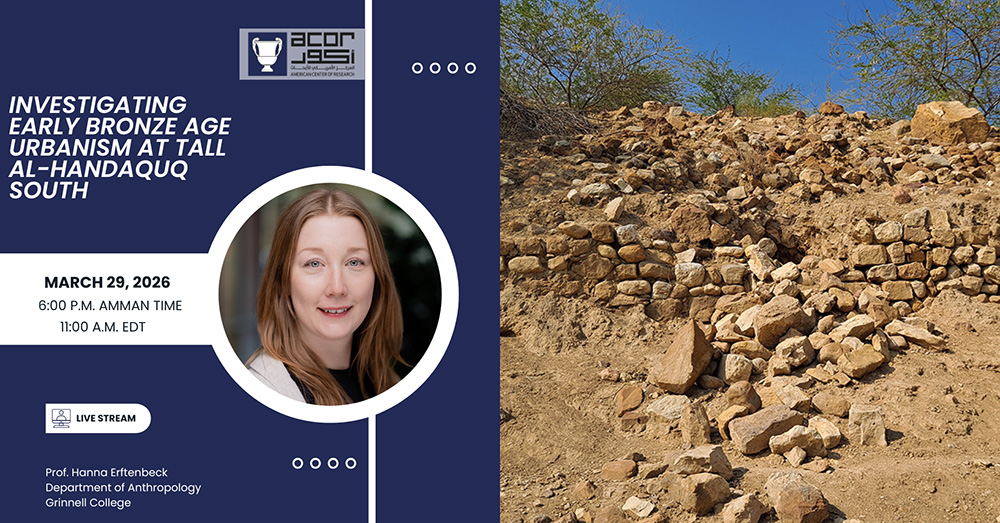
(Please note that this presentation is online only.)
About the Lecture
The Early Bronze Age (c. 3700-2000 BCE) in Jordan was a time of significant social and economic changes, characterized by some of the world’s earliest experiments with urbanism. As people aggregated into larger, fortified settlements they faced difficult decisions, including how to feed, organize, and house their rapidly growing communities.
One of the largest known sites of the Early Bronze Age in Jordan is Tall al-Handaquq South, where excavations in the 1990s uncovered residential spaces offering unparalleled insight into daily life and food practices. In 2025 the Zeighan Ancient Landscapes Project (ZAP) returned to Tall al-Handaquq South to assess spatial organization and establish a preliminary chronology of the site’s occupation history.
This talk draws together legacy data excavated in the 1990s with new data collected from ZAP’s 2025 survey to offer novel preliminary interpretations about site organization, significant size, occupation history that spans the entirety of the Early Bronze Age, and abandonment, thus expanding our understanding of the site and its regional setting.
A Q&A session will follow the presentation.
Date: March 29, 2026
Time: 6:00 p.m. Amman Time (11:00 a.m. EDT)
Place: Online only
Zoom: https://us02web.zoom.us/j/88694025209?pwd=qE58Gv3BHPijpGjkWhbGllyFV3NoJk.1
Webinar ID: 886 9402 5209
Passcode: 910019
YouTube livestream: https://www.youtube.com/@ACORJordan1968/streams
About the Speaker
Dr. Hanna Erftenbeck is an anthropological archaeologist who studies daily life in the past, ancient foodways, and early urbanism. She works as an assistant professor of anthropology at Grinnell College, and her research focuses on exploring experiments with urbanism during the Early Bronze Age (c. 3700–2000 BCE) in Jordan. She is particularly interested in how people’s daily lives changed as they built and maintained new types of communities and uses evidence from household contexts to investigate daily practices and community organization. Dr. Erftenbeck has worked with legacy collections from the Expedition to the Dead Sea Plain and is the co-director of the Zeighan Ancient Landscapes Project.