
26 January 2026
About the Lecture
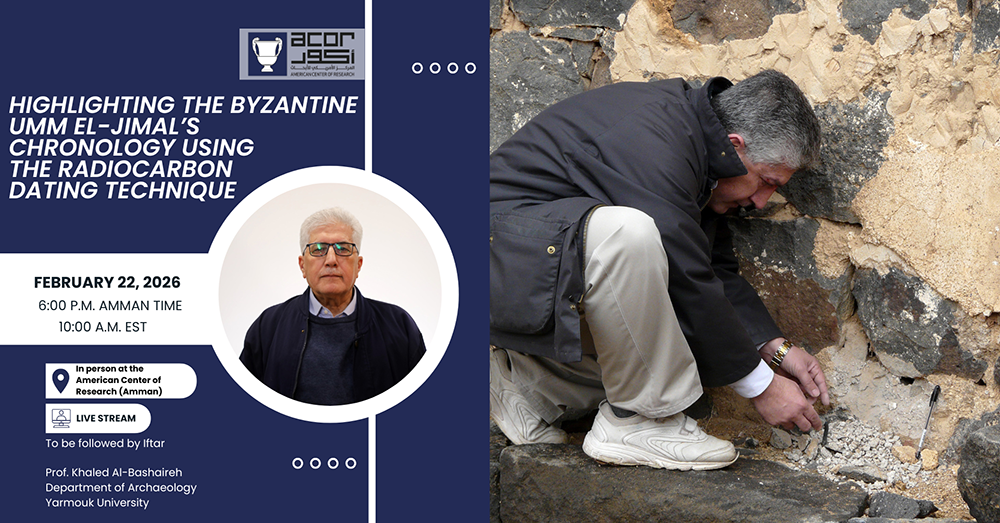
Prof. Khaled Al-Bashaireh will speak about the archaeological site of Umm el-Jimal, which has long drawn the attention of explorers and archaeologists. It attests to about 800 years of continuous occupation, which started in Nabataean times and lasted until the early Muslim period. The site is located in the northeastern area of Jordan, close to Bostra, and belonged to its bishopric. It is distinguished by its large number of churches, which were identified during the surveys, research, and excavations conducted at the site in the past decades. The churches have been dated to the Byzantine period on the basis of their architectural elements and stylistic comparisons to other churches in the region and/or in some cases, their latest ceramics in sealed layers, such as floors. Only two of the churches, the Julianos Church and the Cathedral, were dated by inscriptions not found in situ within them. Bert de Vries dated the North East Church to ca. AD 490 and the Numerianos Church to a later year, and he argued that most of the churches of Umm el-Jimal were probably built during the prosperous late Byzantine period, as were the many churches of the neighboring sites of Khirbet es-Samra, Rihab, and Bostra, among others.
One of the interesting features of the churches is the in situ presence of original cement materials (plaster and mortar) that were used to fill the gaps between stone rows, to cover the internal facades of the walls and apses, and to build mosaics and floors. The cement materials have inclusions of charcoal, straw, and seeds.
The lecture, which will be presented in English, focuses on the use of the 14C technique in dating these organic materials to determine the age of churches of unknown date, to reconstruct their chronological sequence within the chronology of the Byzantine period of the site, and to understand the history of the Byzantine cultural development and religious buildings.
A Q&A session and Iftar will follow the presentation.
Date: February 22, 2026
Time: 6:00 p.m. Amman Time (10:00 a.m. EST)
Place: American Center of Research, Amman (click for directions)
Zoom: https://us02web.zoom.us/j/85783320394?pwd=ibi9oTzlykJCjc43xISj8XeuwZ9YH6.1
Webinar ID: 857 8332 0394
Passcode: 626066
YouTube livestream: https://www.youtube.com/@ACORJordan1968/streams
About the Speaker
Khaled Al-Bashaireh is a professor of archaeometry in the Department of Archaeology of Yarmouk University, where he serves as the dean of the Faculty of Archaeology and Anthropology. He earned his PhD in archaeological science from the University of Arizona. His research focuses on the scientific analysis of ancient materials, specifically using radiocarbon dating (accelerator mass spectrometry) to determine the chronology of monumental structures. He is also a leading expert in the provenance of ancient white and colored marbles across Roman and Byzantine sites in the Levant, in addition to his interest in other topics, including ancient technology, diet, environment, and archaeoseismology.
Prof. Al-Bashaireh was honored (among others) with the General Union of Arab Archaeologists Award for Scientific Merit in 2019 and the prestigious Abdul Hameed Shoman Award for Arab Researchers in 2022 for his outstanding scientific contributions to the humanities. The latter award, one of the most significant in the Arab world, recognized his innovative use of archaeometric techniques to resolve complex historical debates. With over 60 peer-reviewed publications in high-impact journals, he continues to bridge the gap between traditional archaeology and advanced material science, mentoring new generations of researchers in Jordan.